

Deconstructing the Engineering Behind the Dodge Challenger SRT Demon 170’s Sub-9-Second Quarter Mile
In the hallowed halls of automotive performance, few machines command the reverence and sheer, unadulterated terror of a drag strip monster. And among these titans, the Dodge Challenger SRT Demon 170 stands as a modern-day legend, not just for its record-shattering quarter-mile time of 8.91 seconds, but for the audacious engineering feats that make such a brutal display of power possible. This isn’t merely a car; it’s a testament to what happens when engineers are given free rein to chase a singular, ambitious goal: absolute, uncompromised straight-line speed. For car lovers in India, where the roar of a potent engine often takes a back seat to fuel efficiency, understanding the nuances of such a vehicle is an immersive journey into the soul of high-performance automotive design.
The Genesis of a Quarter-Mile King: The Dodge Challenger SRT Demon 170 Engineering Philosophy
The Demon 170 isn’t a happy accident. Its creation stems from a meticulous, almost fanatical dedication to optimizing every single component for drag strip dominance. Dodge, with its storied history of muscle cars, didn’t just tweak an existing Challenger; they fundamentally re-engineered it. The goal was clear: shatter records, and do so with a street-legal machine. This commitment to raw, specialized performance distinguishes it from efforts to create all-rounder supercars like the Porsche 911 Turbo S, which balance track capability with daily drivability. The Demon 170, by contrast, is a laser-focused instrument of acceleration.
The Heartbreak and the Heartbeat: A New Engine for a New Demon
Central to the Demon 170’s prowess is its monstrous engine – a heavily revised version of the iconic 6.2-liter Supercharged HEMI V8. Unlike its predecessors, this engine was designed from the ground up to handle the unique demands of E85 ethanol fuel, which, with its higher octane and cooling properties, allows for far more aggressive tuning. This wasn’t a simple re-calibration; it was a deep dive into metallurgical science and fluid dynamics. The supercharger, for instance, received a 3.0-liter housing, boasting a 40% increase in boost pressure compared to the original Demon. This required a complete overhaul of critical components:
- Connecting Rods: Fortified with higher-strength material and new heat treatment.
- Main and Rod Bearings: Redesigned for improved wear resistance under extreme loads.
- Crankshaft: Forged from a more robust alloy to withstand the immense rotational forces.
- Fuel System: A custom-designed, high-flow fuel system capable of delivering 164 gallons per hour – essential for feeding the beast.
- Cylinder Head Studs: Upgraded to aerospace-grade fasteners for superior clamping force.
- Pistons: Strengthened with improved material and a revised design to handle higher cylinder pressures.
The result? A staggering 1,025 horsepower and 945 lb-ft of torque when running on E85. This isn’t just a number; it’s an engineering statement, a demonstration of pushing internal combustion technology to its very limits within a production car.
Traction is King: The Drivetrain’s Unsung Heroes
Having over a thousand horsepower is one thing; getting it to the ground effectively is entirely another. This is where the Dodge Challenger SRT Demon 170 truly shines, showcasing an integrated approach to traction management that goes far beyond simply bolting on wider tires. This complex interplay of components ensures minimal power loss and maximum hook-up from the starting line.
Reinforced Drivetrain: Handling the Torque Tsunami
The transmission, a fortified 8-speed automatic, receives heavy-duty internals capable of shrugging off the Demon 170’s immense torque. But the reinforcement extends far beyond the gearbox. The driveshaft, a critical link between the transmission and the rear axle, is 30% stronger than the previous Demon’s, while the rear axle housing and stronger half-shafts are also extensively upgraded. This meticulous strengthening prevents the catastrophic failures often associated with such immense power, distinguishing it from less robust setups that might power something like a Honda City. It’s a symphony of steel designed to absorb and transmit violent energy.
Tires: The Ultimate Contact Patch
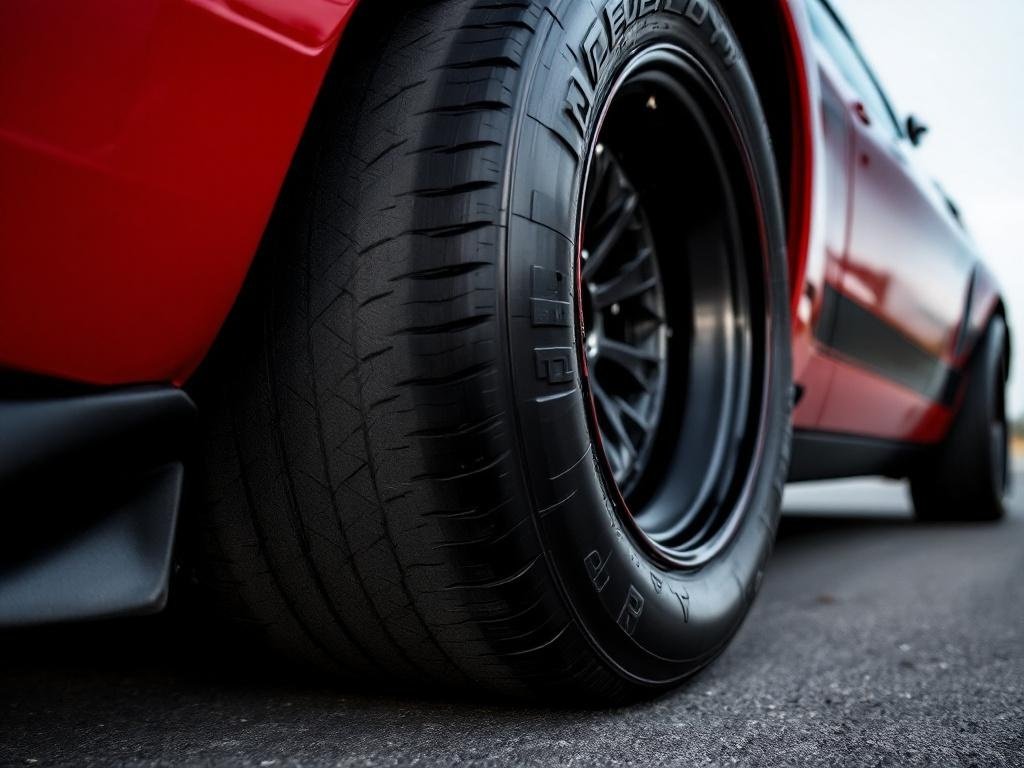
Perhaps the most visually striking and functionally crucial aspect of the Demon 170’s traction strategy is its tires. It’s the first production car to be equipped with street-legal drag radial tires, specifically developed by Mickey Thompson. These 315/50R17 ET Street R tires at the rear offer an enormous contact patch and a specific compound designed to grip the track surface with incredible tenacity. The tall sidewall also plays a critical role, flexing to absorb the initial shock of launch and maintaining maximum contact pressure. This isn’t just about size; it’s about a highly specialized rubber compound and construction tailored for one purpose: immediate, violent acceleration.
Suspension and Chassis: The Launchpad Foundation
Forget cornering prowess; the Demon 170’s suspension and chassis are engineered solely for launching. This means a focus on weight transfer and preventing wheel hop, two crucial factors in achieving those sub-9-second quarter miles. The adaptive damping system is strategically tuned to allow for a significant amount of weight transfer to the rear during launch, effectively “squatting” the car onto its rear tires for maximum grip. The Demon 170 also features a unique launch control strategy that actively manages engine torque and ignition timing to prevent wheel spin and achieve the perfect launch every single time.
Lightweighting: Every Gram Counts
While a large V8 muscle car might not immediately conjure images of lightweighting, the Demon 170 employs several judicious weight-saving measures. From a deleted front passenger seat (optional reinstall), removed rear seats, and a minimal sound system, to lightweight wheels, every effort was made to shave off superfluous grams. This isn’t about setting a lap record on the Nürburgring; it’s about reducing inertia off the line. This philosophy is in stark contrast to luxury vehicles like the Rolls-Royce Cullinan Cosmos Edition, where opulent features inevitably add considerable mass.
The Aerodynamic Advantage (or Lack Thereof)
On a drag strip, top-end aerodynamics are less critical than for a road course car. The Demon 170’s focus is on straight-line stability and managing lift, not generating downforce for high-speed cornering. Its wide, aggressive stance and subtle front splitter work to channel air effectively, but the primary aerodynamic concerns revolve around cooling the monstrous engine and brakes, and maintaining stability at triple-digit trap speeds.
Software: The Unseen Conductor of Power
The Dodge Challenger SRT Demon 170 engineering triumph isn’t just about brute mechanical force; it’s also a masterclass in software calibration. The powertrain control module (PCM) is a highly sophisticated unit that constantly monitors hundreds of parameters, from air temperature and humidity to fuel octane levels. It dynamically adjusts boost pressure, ignition timing, and fuel delivery to extract maximum power safely and consistently. The “Direct Connection” tuning, accessible through an ECU flash, unlocks the full potential when E85 fuel is detected, demonstrating a level of factory-supported tunability typically reserved for aftermarket specialists. This intelligent integration of software makes the Demon 170 not just powerful, but remarkably precise in its brutality.
The Legacy of the Demon 170
The Dodge Challenger SRT Demon 170 is more than just a swan song for the HEMI V8; it’s a defiant roar against the tide of electrification. It represents the pinnacle of internal combustion drag racing technology in a production car, a raw, visceral experience that will likely never be replicated. For automotive enthusiasts, particularly those who revel in the meticulous details of automotive engineering and culture, the Demon 170 is a tangible piece of history, an icon forged in fire and fueled by an uncompromising pursuit of speed. It showcases what’s possible when a manufacturer throws caution to the wind and builds a machine with a singular purpose, reminding us all of the exhilarating potential that lies within the roar of a supercharged V8.

Passionate car enthusiast and content writer, bringing you the latest from the world of horsepower and high-octane. Falak Thakur combines a love for all things automotive with a talent for crafting compelling stories.